Offsetting CO2 when you fly: all you need to know
Compared to other forms of transport, flying is very harmful to the environment. However, if you cannot do without flying, you should consider offsetting your carbon emissions.
There are many options available, which vary both in price and in the way they calculate emissions. We give you an overview of sustainable travel and what to look out for if you want to improve your carbon footprint.
Contents
- What is a carbon offset?
- Offsetting CO₂ - how do I do it?
- Frequently asked questions about CO₂ offsetting in aviation
- What should I look out for when buying voluntary carbon offsets?
- Offsetting CO₂ emissions through the airline
- Offsetting through an independent organisation
- CO₂ offsetting through a flight booking portal
- What are the problems with carbon offsets?
What is a carbon offset?
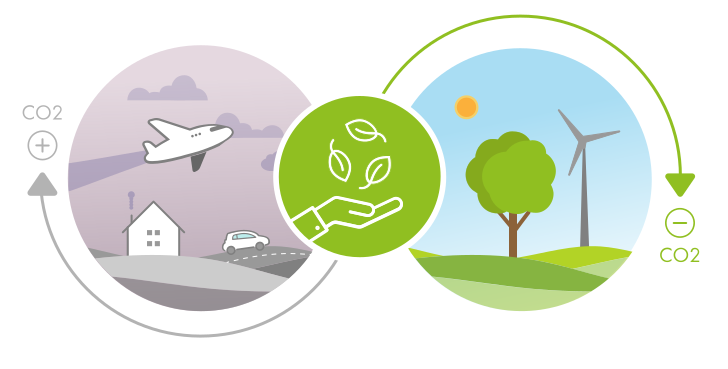
A carbon offset allows you to compensate for the emissions caused by your flight.
Offsetting means that the same amount of CO₂ is saved elsewhere, usually through climate change projects. This usually involves
- Promoting renewable energy: e.g. building wind turbines, solar panels or biogas plants
- Measures to increase energy efficiency: e.g. more efficient stoves or improved waste recycling in developing countries
- Reforestation of forests or protection of peatlands
More detailed information on individual carbon offset projects can be found on the websites of the respective carbon offset providers. You will usually also find information and evidence of certified projects.
Offsetting CO₂ – how do I do it?
The first thing you need to do is calculate the emissions from your flight. The best way to do this is to use a CO₂ calculator. Many airlines and offsetting service providers offer these calculators.
Example: Emissions calculator from atmosfair
Then buy an emission right from the provider – often called a certificate or simply an offset contribution.
You can do this on the provider’s website.
For a return flight from Berlin to Barcelona for one person, the CO₂ emissions are about one tonne.
The amount of the donation is between €1 and €24, depending on the provider.
The money goes to the provider’s climate project, which saves carbon dioxide.
You can often choose from a number of climate projects.
Once you have made the payment, you will receive a document confirming the amount of your carbon offset.
It doesn’t always have to be flying
Offsetting is always the second-best solution, because every flight has an impact on the environment.
Planes emit not only carbon dioxide, but also nitrogen oxides, soot particles, aerosols and water vapour, which heat up the atmosphere.
It is more environmentally friendly to travel by train or coach.
Frequently asked questions about CO₂ offsetting in aviation
A carbon calculator allows you to calculate the amount of emissions you have caused, i.e. the carbon footprint of your trip.
The amount of CO₂ determines the amount of compensation you will receive. Many airlines and independent organisations have their own carbon calculators on their websites.
The more information you provide before the calculation, the more accurate the result.
Important information includes
- Departure/destination airport,
- Stopovers,
- Number of flights/people,
- Aircraft type (optional),
- Flight class: seat class, scheduled or charter flight.
According to experts, the CO₂ calculator of the German Federal Environment Agency should provide accurate values.
Other CO₂ calculators are available at
Yes, as long as the projects have actually been carried out and deliver additional climate benefits. Look for standards or labels.
It is important that the project is ONLY done through offsetting.
Projects that are carried out without compensation do not really offset carbon emissions.
An example:
A project operator in Nepal builds a biogas plant for which it receives a government subsidy.
The plant is therefore built even without carbon offsetting.
Paying for it would simply increase the project operator’s profit.
Standards are intended to guarantee that emissions are offset and that climate protection projects actually save CO₂.
Standards are therefore seals of approval for climate protection projects.
The websites of some offset service providers show the projects that have been checked and certified according to the standards.
So look out for designations such as “CDM Gold Standard Projects” or “VER Gold Standard Projects”.
There are different standards with different criteria, including:
International Standards
These climate protection projects meet particularly high standards. They save carbon dioxide and at the same time contribute to sustainable local development.
This is the standard based on the Kyoto Protocol. The United Nations has defined the test criteria.
Thus, every climate protection project must be inspected by the CDM Executive Board, an authority of the United Nations. Certificates for projects with the CDM standard are called “CER: Certified Emissions Reduction” and certify the CO₂ savings.
The projects are verified by experts. However, according to the Federal Environment Agency, there is no central recognition procedure (for more details, see the guidebook “Voluntary CO₂ compensation through climate protection projects”). The certificates for projects with the VCS standard are called VER (Verified/Voluntary Emissions Reductions).
National standards
Some NGOs and countries have developed standards for evaluating national carbon offset projects.
For example
Complementary standards
Complementary standards do not focus primarily on carbon savings, but on the impact of the project on other areas.
This is because climate change projects can also cause damage, for example when people have to be resettled or nature is destroyed by the construction of a hydropower plant.
Additional standards are designed to ensure that this does not happen. These additional standards include the following
- Social Carbon Standard
- Climate, community and biodiversity standard
- Plan Vivo Standard
These are only available in combination with classic standards such as the Gold Standard.
There are significant differences in the cost of offsetting between airlines and carbon offsetting companies.
There are a number of reasons for this:
- Different calculation methods
Carbon offsetting providers classify the same flight as having different impacts. This is due to the amount of carbon dioxide emitted and the fact that carbon dioxide is released at high altitudes, where it is particularly harmful. Suppliers have to take both into account when calculating compensation. Suppliers have different calculation methods (RFI factor), especially when it comes to emissions at high altitudes. - Project quality and cost-effectiveness
Some carbon offset providers provide detailed information on this. This can be an annual or financial report that shows the relationship between revenues and promised carbon reductions. - The country where the climate project is being implemented
Costs are usually lower in developing countries. - Number of credits from a project
As the quantity increases, the unit price decreases. - Different strategies
In addition to offsetting emissions, some providers are also committed to social aspects such as fighting hunger and poverty, education or social compatibility. This can result in a higher price for the carbon offset.
Your offset is tax deductible under the following conditions:
1. The organisation you pay the offset to must be a non-profit organisation.
For example, atmosfair, klima-kollekte, PrimaKlima or myclimate.
Check the imprint and the terms and conditions to find out who runs the website and whether it is a non-profit organisation. Here are some hints:
- gGmbH
a non-profit limited liability company - e. V.
Registered association. But be careful, not every registered association is charitable. You can often find information on the association’s website about whether you can deduct your contribution from your tax bill. If not, ask. - Foundation
Not all foundations are charitable. Check the website to see if you can deduct your donation from your tax bill. If in doubt, ask. - Organisations in other EU countries
It is usually more difficult to get a tax deduction here. You must prove that the organisation is a charity. The Bundesfinanzhof has set out the criteria in its ruling: You must submit documents that allow a precise examination of the organisation’s management, such as an activity or accountability report. The organisation must have submitted this report to the foreign supervisory authority. Your tax office in Germany will then decide whether the organisation is a charitable organisation.
2. You must be able to provide proof of payment. For amounts up to €200, a bank statement or paying-in slip is usually sufficient. For larger amounts, you will need a donation receipt.
3. The payment must exceed 36 euros.
4. Your donation does not exceed 20% of your income.
Biofuels and E-fuels
Some airlines offer the option of using CO₂-neutral kerosene, known as Sustainable Aviation Fuel (SAF), on their flights for a surcharge.
This option is usually offered at the time of booking.
The fuel is made from plant products such as palm oil. One problem with this is that it takes land out of food production.
Other providers rely on biofuels made from frying fats and industrial waste.
In all cases, production is still expensive and requires a lot of energy.
Depending on the amount you pay, a certain amount of biofuel is added to the paraffin.
However, the biofuel you buy is not usually used on your own flight.
According to a draft EU law, airlines will be required to use 2% Sustainable Aviation Fuel (SAF) from 2025.
E-fuels are made from green hydrogen and are still a rare commodity. However, the EU wants to make the use of e-fuels mandatory for airlines from 2030. They will then have to add a certain amount to their fuel.
More efficient aircraft
New aircraft generally use less fuel than older ones.
For example, using an Airbus A350 can reduce CO₂ emissions by 25 per cent.
Buying carbon credits (CO2 certificates)
Your donations will be used to buy certificates from the European Emissions Trading Scheme. These certificates are no longer available to industry, so they have to cut their CO2 emissions. More at compensators.org
Filtering CO2 from the air and storing it underground
In a complex technological process (DAC: Direct Air Capture), carbon dioxide is extracted from the air and permanently stored underground. The costs are still very high. More at climeworks.com
What should I look out for when buying voluntary carbon offsets?
You should only pay money for CO₂ offsetting to reputable offsetting service providers.
You want to be sure that the carbon dioxide from your flight is being offset and that the money is going where it is supposed to go.
So look carefully at the offset provider’s website.
The following checklist gives you some pointers on how to distinguish between reputable and dubious providers.
Checklist: Offsetting flight emissions
- You will receive clear and understandable information about the carbon offset projects supported by your payments.
- You will be made aware that avoiding emissions is the most important thing to do and the least damaging to the environment. The principle is “avoid – reduce – offset”.
- You will be asked to provide detailed information about your flight (departure airport, destination airport, stopovers, type of aircraft). This is the only way to correctly calculate the amount of carbon dioxide emissions.
- Pay attention to standards / labels. For example, if there is a reference to the gold standard, you can assume that the climate project has been verified.
- Make sure that you receive confirmation of your payment (often in the form of a PDF document).
- Do you want to use your payment for other purposes? Look for additional standards that take those goals into account.
Offsetting CO₂ emissions through the airline
Some airlines allow customers to offset their carbon emissions either during or after booking.
Airlines usually work with external partners, either commercial companies or non-profit carbon offsetting organisations.
Airlines use a variety of methods to enable their customers to offset their emissions.
The main approaches are as follows
- The emissions of the flight are not calculated. The airline spends a fixed amount each year on carbon offset projects.
- CO₂ emissions from flights are automatically offset by the airline.
- Consumers can choose how much they want to offset. The payment is made to an independent climate protection organisation.
- The airline offers its customers a fixed, relatively small amount of compensation, regardless of the amount of carbon dioxide actually produced.
- The airline uses a CO₂ calculator to determine the amount of carbon dioxide generated by the flight. It works with an external offsetting provider.
- The CO₂ contribution is calculated, but no compensation is paid.
- Some airlines offer their customers the opportunity to purchase biofuel at the time of booking.
CO2 offsetting programmes of European airlines (as of July 2023)
The airline does not offer CO2 offsetting.
As part of a “Sustainable Aviation Fuel” (SAF) programme, aircraft departing from Thessaloniki are (also) fuelled with sustainable kerosene.
Visit en.about.aegeanair.com for more information.
Passengers can offset their carbon emissions both at the time of booking and afterwards.
With the help of Climate Austria’s CO₂ calculator, you can calculate the carbon dioxide emissions of your trip.
Climate Austria is a product of Kommunalkredit Public Consulting GmbH, which advises on climate protection projects and implements funding programmes, particularly in the field of environmental and climate protection.
You can choose to pay the suggested amount or a different amount.
Customers can also choose whether to fund Austrian or international climate protection projects.
CO₂ calculator from the Austrian Ministry of the Environment
The airline does not offer CO2 offsetting. However, it aims to halve CO2 emissions on half of its flights. The following measures will be used:
- Modernisation of the fleet. Increased use of aircraft with lower fuel consumption.
- Use of sustainable aviation fuels
- Environmentally friendly flight procedures (adjustment of flight routes, reduction of weight on board, continuous descent).
The airline also supports processes to filter CO2 from the atmosphere.
For further information, please visit airfrance.com
Passengers can make a donation to the not-for-profit organisation Pure Leapfrog during the booking process or afterwards.
The emissions of the specific journey are not calculated.
The amount of the donation is up to the customer.
British Airways will automatically offset flights within the UK from January 2020.
Donations made through the British Airways website will benefit the following types of projects
- renewable energy
- Rainforest conservation
- Reforestation programme
You can offset your carbon emissions when you book your flight or afterwards.
Alternatively, CO2 emissions can be offset by purchasing sustainable aviation fuel (SAF).
Eurowings works together with the Swiss climate protection foundation myclimate and the Compensaid platform.
More information at eurowings.com
The airline offers the option of voluntary CO2 offsetting. To calculate the amount of CO2 generated by a flight, the airline provides a CO2 calculator on its website:
The airline has also joined the UN-backed Race to Zero initiative. The initiative aims to reduce CO2 emissions to 0 (net) by 2050.
The airline also supports the development of zero emission aircraft, such as Airbus’ ZEROe programme, and the development of technologies to capture CO2 from the air.
Visit easyjet.com for more information.
Finnair aims to be carbon neutral by 2045.
For example, passengers can use “Finnair Plus points” for a specific purpose, including a nature conservation organisation.
They can also make a contribution to sustainable kerosene or support certified climate projects.
Finnair cooperates with the company CHOOSE.
Iberia created the Co2llaborate programme to achieve its sustainability goals.
Among other things, it allows
- Calculate its carbon footprint
- Offset CO2 by supporting trusted climate projects
Since 2008, passengers have been able to add the CO2ZERO offsetting service to their booking. CO₂ offsetting is only possible during the booking process, not afterwards.
Emissions are calculated by KPMG’s sustainability department.
The “gold standard” is used for the audit.
According to KLM, the compensation will be used to support sustainable environmental projects in Ghana, Mali, Uganda and Kenya.
Customers can find more information on how to calculate the offset per destination on the KLM website.
Passengers can calculate and offset the emissions of their trip during or after booking.
They can choose whether the flight is to be offset by planting trees or by replacing kerosene with CO₂-neutral synthetic fuels (SAF = Sustainable Aviation Fuel).
It is also possible to use both offsetting options.
Lufthansa works together with the Swiss climate protection organisation myclimate.
The airline offers to offset the carbon emissions of the flight booked during the booking process.
Norwegian Air works with the environmental company CHOOOSE.
The offsets will benefit projects certified by the United Nations and the Gold Standard.
These include a wind energy project in Vietnam and a project in Thailand that converts landfill gas into energy.
When booking a flight, passengers can voluntarily choose to make a contribution to minimising CO₂ emissions.
The minimum amount is three euros, regardless of the route. Customers can also choose to contribute more.
The amount of carbon dioxide produced can be calculated using a CO₂ calculator.
However, it does not calculate the amount of money needed to compensate.
LOT announces on its website that it has signed an agreement with the State Forestry Service of Poland.
The DestinationECO programme aims, among other things, to improve the natural regeneration and reforestation of Polish forests.
Passengers booking a flight with Ryanair can choose to make a voluntary compensation payment at the end of the booking process.
This is usually one euro for a return flight within Europe.
The donation should be made to one of the following climate change organisations
SAS customers have the option to purchase biofuel for their flight during the booking process.
The airline says this will reduce emissions by up to 80 per cent.
SAS says it will pay compensation for passengers under the age of 26 and those participating in the Euro Bonus programme.
Passengers can voluntarily offset the CO₂ emissions of their trip when booking.
The amount of the offset is calculated using the International Civil Aviation Organisation (ICAO) method.
According to TAP Air, the proceeds will be donated to projects certified by the United Nations.
Wizz Air has partnered with the CHOOSE organisation.
Passengers can offset their emissions using a CO2 calculator. Wizz Air supports a tree planting programme in Uganda and a project to convert Pichacay landfill gas into renewable energy in Ecuador.
Greenwashing: How airlines deceive their customers
Greenwashing is the practice of telling customers that they are flying green when they are not.
In particular, airlines that offer carbon offsetting are often accused of trying to project a green image.
This is the case, for example, when the amount of compensation offered is understated and does not offset the actual amount of carbon dioxide emitted by the flight.
What to look for in airlines
It must be clear how the airline calculates the amount of carbon dioxide and the amount of compensation. If the airline offers a flat rate, this is not transparent.
Procedures that allow the consumer to choose the level of compensation are also critical.
Again, it cannot be assumed that the amount of carbon dioxide actually generated will be offset.
In case of doubt, the values of the CO₂ calculator of the Federal Environment Agency should be used.
Another point of criticism is that not all airlines provide clear and understandable information about their carbon offset projects.
Offsetting through an independent organisation
There are a large number of free providers around the world that also offer carbon offsetting.
Depending on the provider, compensation is offered for individual flights, but also for other areas of life such as car use, heating, electricity and food.
Here is a selection (as of July 2023)
- AQ Green Tec (DE)
- Atmosfair (DE)
- BUND Moorland-Projekt (DE)
- carbon footprint (UK)
- Carbonsink (IT)
- ceroCO2 (ES)
- CHOOOSE (NO)
- ClimateAustria (AT)
- Climate Impact Partners (UK)
- Climeworks (CH)
- co2logic (BE)
- CO2Web (IT)
- Compensate (FI)
- Eco-act (FR)
- Ecogood (DE)
- Ecotree (FR)
- Fair Climate Fund (NL)
- First Climate (DE)
- Fondation GoodPlanet (FR)
- Forest Carbon (UK)
- Greenmiles (DE)
- Greenseat (NL)
- Greentripper (BE)
- Ilmastoapu.fi (FI)
- Klima-Kollekte (DE)
- myclimate (CH)
- Primaklima (DE)
- Trees for All (NL)
CO₂ offsetting through a flight booking portal
So far, only a few booking portals offer their customers the opportunity to improve their carbon footprint.
On the comparison portal idealo, a new browser window opens during the booking process and redirects the user to the website of carbon offset provider atmosfair.
The booking portal Skyscanner highlights flights that emit less than the average amount of emissions.
When searching on Momondo, easyVoyage or Grüner-Fliegen, you can sort the suggested flight connections according to carbon dioxide emissions.
After selecting a flight, the amount of money needed to offset the emissions is also displayed.
Once you have made your booking, you can choose to offset your carbon emissions.
What are the problems with carbon offsets?
Some offsets do not reduce carbon dioxide. This can happen for the following reasons
This can happen if the provider does not ask for detailed flight data and sets the offset too low.
In this case, you will not be compensated for the amount of emissions you have actually caused.
Consumers are still led to believe that they are flying in a climate-friendly way. This is known as greenwashing.
When in doubt, experts recommend using the Federal Environment Agency’s CO2 calculator.
Your payment may not contribute to climate action at all.
For example, if a government already provides financial support for the project, the wind or solar power plant would have been built in that country even without your payment.
It is not always possible for consumers to check whether their payment is making an additional contribution to climate protection. This is where standards can help.
One reliable standard is the Gold Standard.
A certificate is a pollution right that can only be sold once in order to actually contribute to an offset.
However, it is possible that you buy a certificate from the supplier that has already been sold to someone else, for example a government that wants to use it to improve its carbon footprint, or another private individual who wants to offset their flight in the same way as you.
This is called double counting.
An example
A biogas plant permanently saves carbon dioxide.
The operator receives one allowance per tonne. Another country produces carbon dioxide by running a coal-fired power station.
This country buys allowances from the biogas plant operator to compensate for the carbon dioxide produced by the coal plant.
If you now want to offset the emissions from your flight, you can no longer use the certificates bought by the government.
It is almost impossible for consumers to check whether the certificate has already been used.
This is because there is no central registry where the certificates are recorded.
Carbon offsetting projects make sense when carbon dioxide is permanently removed from the atmosphere.
This is the only way to improve your carbon footprint.
This can be a problem with projects that involve planting trees.
This is because, on the one hand, trees absorb CO2 from the atmosphere (photosynthesis) and, on the other hand, carbon dioxide is released back into the atmosphere when the wood is cut and burned or destroyed by pests.
Therefore, when choosing a project, pay attention to the standards.
You may also be interested in
Funded by the European Union. Views and opinions expressed are however those of the author(s) only and do not necessarily reflect those of the European Union or the European Innovation Council and Small and Medium-sized Enterprises Executive Agency (EISMEA). Neither the European Union nor the granting authority can be held responsible for them.
Was this article helpful for you?